
Adapting Asset Manager Operating Models for Family Office Clients


Inrecent years, family offices have emerged as a powerful force in the wealth management landscape. As ultra-high-net-worth individuals (UHNWIs) seek more personalized and comprehensive financial services, asset managers must evolve their operating models to meet the unique needs of these sophisticated clients. This article explores the challenges and opportunities in adapting asset management services for family offices, offering insights into best practices and future trends.
The Rise of Family Offices
Family offices have experienced remarkable growth over the past decade. According to a report by Mordor Intelligence, the global family office market is expected to grow from USD 18.90 billion in 2024 to USD 25.93 billion by 2029, at a CAGR of 6.52%. This surge is driven by increasing wealth concentration among UHNWIs and a desire for more tailored wealth management solutions.
Current Challenges for Asset Managers
Traditional asset management models often fall short when serving family office clients due to several factors:
Complexity of needs: Family offices require a broader range of services beyond investment management, including tax planning, philanthropy, and intergenerational wealth transfer.
Demand for customization: UHNWIs expect highly personalized strategies and reporting tailored to their unique circumstances.
Multi-asset class expertise: Family offices often invest across a diverse range of asset classes, requiring managers to have broad expertise.
Privacy and control: Family offices prioritize confidentiality and maintaining control over their wealth management decisions.
Key Areas for Adaptation
To effectively serve family office clients, asset managers must adapt their operating models in several crucial areas:
Technology Integration
Family offices increasingly demand sophisticated technology solutions to manage their complex portfolios. Asset managers should invest in robust platforms that offer:
Real-time portfolio monitoring
Advanced analytics and reporting capabilities
Secure data management and communication tools
Customized Reporting
Family offices require detailed, customized reports that go beyond standard performance metrics. Asset managers should offer:
Consolidated reporting across all asset classes and entities
Customizable dashboards and visualization tools
Integration of non-financial assets (e.g., art collections, real estate)
Multi-Asset Class Management
Asset managers must expand their expertise to cover a wide range of asset classes, including:
Traditional equities and fixed income
Alternative investments (hedge funds, private equity)
Real estate and direct investments
Digital assets and cryptocurrencies
Risk Management
Family offices often have complex risk profiles that require advanced risk management capabilities:
Comprehensive risk assessment across all holdings
Scenario analysis and stress testing
Integration of qualitative factors (e.g., reputational risk)
ESG and Impact Investing
Many family offices are increasingly focused on aligning their investments with their values. Asset managers should offer:
ESG integration across all asset classes
Impact measurement and reporting
Access to sustainable and impact investment opportunities
Best Practices for Asset Managers
To optimize their services for family office clients, asset managers should consider the following best practices:
Develop a holistic understanding of each family’s unique needs and goals
Invest in flexible technology platforms that can accommodate customization
Build multi-disciplinary teams with expertise across various asset classes and services
Offer education and support for next-generation family members
Prioritize transparency and clear communication in all interactions
Stay informed about emerging trends and opportunities in the family office space
Future Trends
As the number of family offices continues to grow, asset managers must prepare for several emerging trends:
Increased focus on digital assets and blockchain technology
Growing demand for sustainable and impact investing solutions
Rise of artificial intelligence and machine learning in portfolio management
Greater emphasis on cybersecurity and data protection
Expansion of family office services in emerging markets, particularly Asia
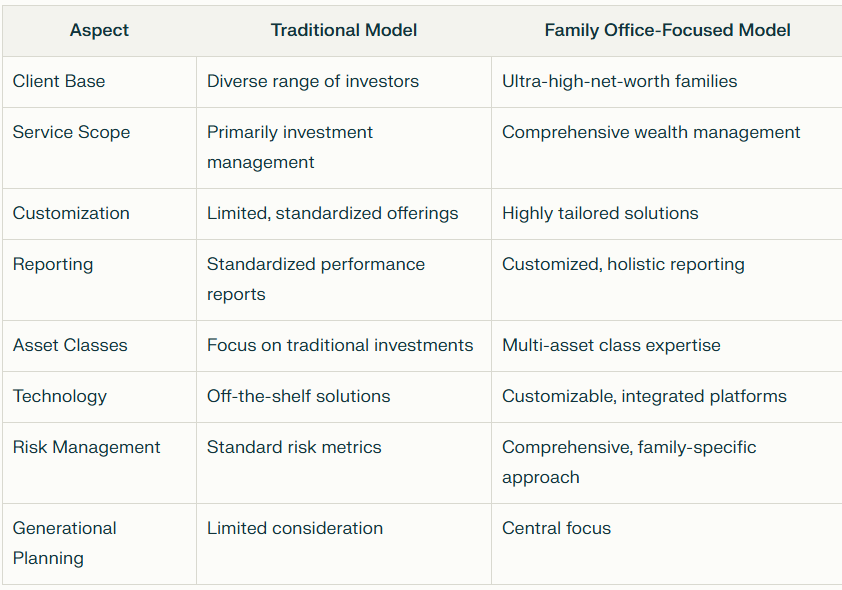
Comparison: Traditional vs. Family Office-Focused Asset Management Models
Conclusion
As family offices continue to grow in number and sophistication, asset managers must adapt their operating models to meet the unique needs of these clients. By focusing on technology integration, customized reporting, multi-asset class expertise, advanced risk management, and ESG considerations, asset managers can position themselves as valuable partners to family offices. Those who successfully navigate this transition will be well-positioned to capture a significant share of the expanding family office market in the years to come.
References:
https://www.fsdc.org.hk/en/media/family-offices-wealth-management-s-jewel-in-the-crown
https://www.mordorintelligence.com/industry-reports/global-family-offices-industry
https://www.ocorian.com/insights/part-one-spotlight-asia-4-reasons-set-family-office-hong-kong
https://www.aima.org/article/five-operational-challenges-facing-the-modern-family-office.html
https://www.optionsgroup.com/insights/replacing-the-family-office-chief-investment-officer/https://www.investopedia.com/terms/f/family-offices.asp